
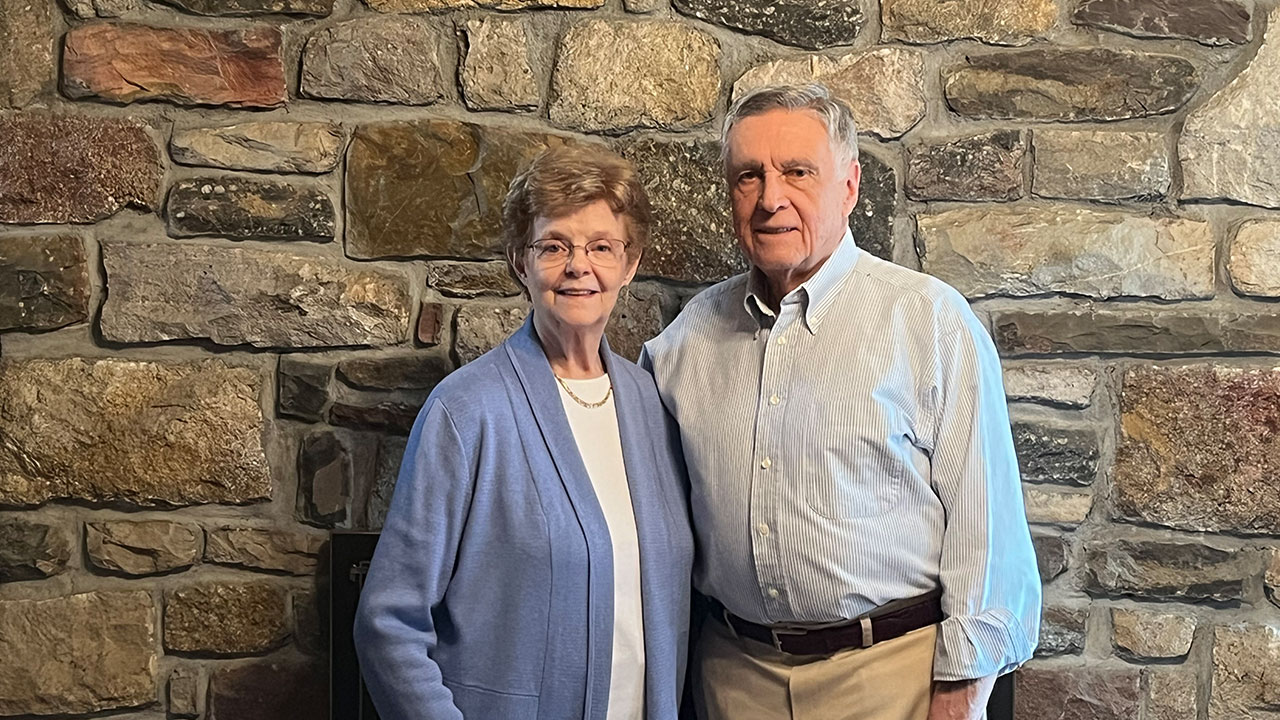
MARTHA M. '65 AND RONALD M. TIRPAK
Hailing from working-class roots in the coal region of Pennsylvania, the Tirpaks' belief in paying it forward and giving others a hand up led to the establishment of the Martha M. '65 and Ronald M. Tirpak Endowed Scholarship at the East Stroudsburg University Foundation for students majoring in elementary education from Carbon County, Pennsylvania.
Philanthropy starts at home
Martha M. 65 and Ronald M. Tirpak create scholarships to assist
students from Carbon County
By Sara Karnish
Martha Miller Tirpak 65 has always believed education is the key that can unlock the door to many opportunities. It helped her chart her own course as a teacher, and now she and her husband Ron are helping the next generation of educators.
Hailing from working-class roots in the coal region of Pennsylvania, the Tirpaks belief in paying it forward and giving others a hand up led to the establishment of the Martha M. 65 and Ronald M. Tirpak Endowed Scholarship at the East Stroudsburg University Foundation for students majoring in elementary education from Carbon County, Pennsylvania. Rons work for PennDOT and later as principal for his firm Carbon Engineering opened the couples eyes to the area theyve always called home.
We realized Carbon County is not a very rich county and we wanted to give back. One way to do this was to set up a scholarship for students who couldnt really afford an education, Martha said.
When Martha was looking at colleges, she chose ESU, then known as East Stroudsburg State College (ESSC), for a few reasonsnamely, the cost and its proximity to her home. My dad had passed away so we needed something affordable. I had a friend who was going to the college so we could come home every weekend. It was also known as a great school for education, and I wanted to be an elementary school teacher, she says.
A few memories of her days at East Stroudsburg stand out. As a freshman, Martha lived at the former Indian Queen Hotel on Main Street in Stroudsburg, which was used as a freshman girls' dorm due to a lack of on-campus housing. The building was built in 1843 and was converted into a hotel in the 1870s.
My roommate and I had a large room which was connected to the 'bridal suite' that housed three girls. We would take the bus up to campus for our classes and meals. We had two house mothers who would inspect our room every couple of weeks to make sure it wasn't a mess. I cant imagine that happening today, she laughs. It was different, living in such an old building. But it was interesting and I did meet some nice girls. (The hotel was demolished in the early 60s and Citizens Bank now stands on the site. Martha lived in Stroud Hall in her sophomore year).
She also recalls freshman hazing, which was commonplace at that time. We had to wear these little black and red beanies called dinks anytime we were on campus. We were given a booklet that we had to study, and if an upperclassman ever approached us, they could ask us a question from that booklet and we had to know the answer. It was just a way to let us know we were the low men on the totem pole, she recalls.
She was at East Stroudsburg during some of the most historic moments of the
1960s, including the Cuban Missile Crisis and President John F. Kennedys
assassination. I was in English class, she recalls of that tragic day in
1963. All classes were canceled and everyone got to go home."
She completed her student teaching in kindergarten and second grade at Lehighton Area School District, also in Carbon County. She was offered her first teaching job in that district after she earned her degree in education in 1965. She taught second grade for four years before taking time off to raise her family. "I didnt go back to teaching until our daughter was in third grade, and then I went back to substitute teach at Panther Valley [in Carbon County] because I didnt want to work full-time, she said. After two years back in the classroom, Tirpak changed professional paths. She worked in her husband Rons engineering firm for many years until the couple retired.
Although Marthas professional life took a different direction from her original goal of teaching, she and Ron remain committed to helping future teachers. We need good teachers, she says. Its a demanding job, but we definitely need them.
Besides ESU, the Tirpaks have established scholarships at Penn State, Rons alma mater, for students pursuing engineering, IT, and science degrees. Ron, too, remembers what it was like to be a college student who needed some extra help. I had to drop out one semester because I ran out of money, and I had to earn enough to go back. We thought we might want to give back to students from Carbon County who could use the help.
The Tirpaks put their son and daughter through college, and as they looked to retirement, they wanted to help other students with their college journey. Estate planning has been a tremendous resource. A portion of our estate will go to ESU, and a portion will go to Penn State, Ron said. We decided to sponsor scholarships, and with the additional funds well be giving through the estate, it will increase the value of the scholarship.
Martha admits she has not been back to campus as often as she would have liked since graduating in 1965, but she and Ron did attend a scholarship recipient dinner recently and remarked on how different the campus looks since she was a student.
The campus may look different, but ESUs core values havent changed. I still think its a very cost-effective education. Its a reasonable drive for many students who have to commute or live close to home. I think going to ESSC helped me grow up a bit, and it helped me develop as a teacher. I earned my degree, and I proved to myself I could do it, Martha says, adding she was only the second member of her family to attend college. Those early experiences shaped her outlook and inspired her to help others.
"There always seem to be a lot of scholarships offered for sports, but not for the students in education and the sciences. If you can afford it, consider helping students financially to get an education and a chance to better themselves, she said.